Oracle · 2018–2022

Product Transformation at Scale

I scaled the team from 3 to 15 across design and research, managing 5 direct reports, and drove the automation work that transformed how hundreds of thousands of people submit expenses and process invoices across Oracle’s Enterprise Resource Planning (ERP) suite—work that reached Larry Ellison and made me the first sub-VP designer to present at Oracle’s Financials Strategy Council.

3 → 15

team scaled

75%

max reduction in manual effort

1.7M+

customers reached annually

5

patents (3 issued, 2 filed)

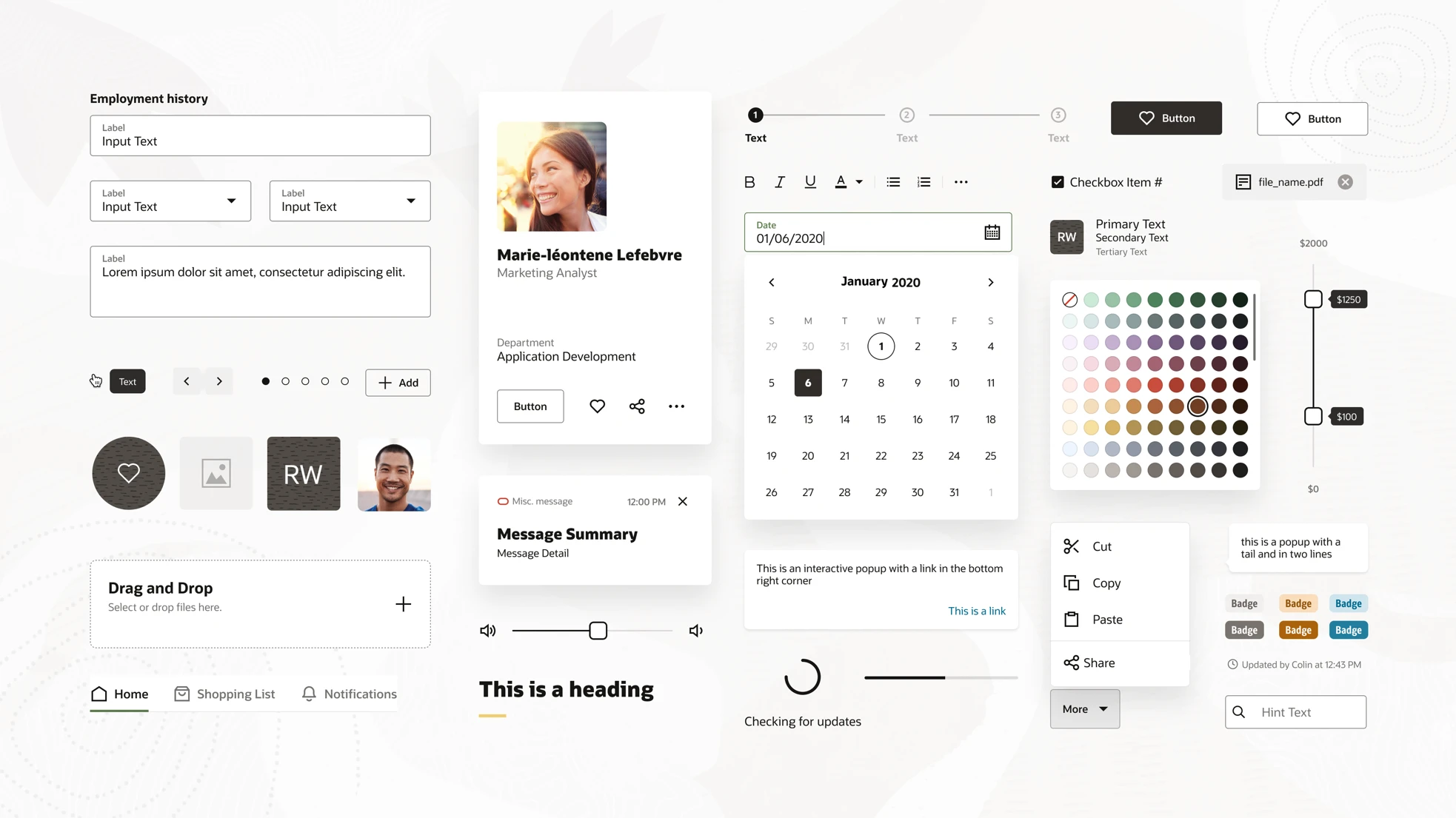
Oracle’s next generation user experience, featuring work from Expenses.

I joined Oracle as one of the early hires in a ground-up effort to transform the company from an engineering-led enterprise software organization into a more unified, design-led one. Our impact stretched far beyond redesigning products—it meant reshaping the culture, operating model, and expectations for what great customer experience could look like at Oracle. Oracle might not be the company that immediately comes to mind when people think of design excellence—and that was exactly what I loved about it. Surrounded by some of the most talented designers of my career, I got to help expand the role and influence of design across the organization—and watch that shift begin to take hold.

Kelly built strong relationships with the business, reinforcing confidence in the ERP product teams during a critical period for the org.
— Winston Wang · VP of UX Design, AI Data Platform, Analytics, ERP, EPM
Kelly brings a rare combination of humility when she is unsure and a gentle firmness on her convictions.
— Vasudha Chandrasekaran · VP, Oracle UX Research
2018–2020

Redefining Oracle Expenses

RoleDesign lead, vision through delivery

Details coming soon

Oracle Expenses was selected as one of four products to lead Oracle’s next-generation product transformation. Used by more than 100,000 people across 369 companies, it had enormous reach—but years of accumulated complexity had made one of the most common workplace tasks unnecessarily cumbersome.

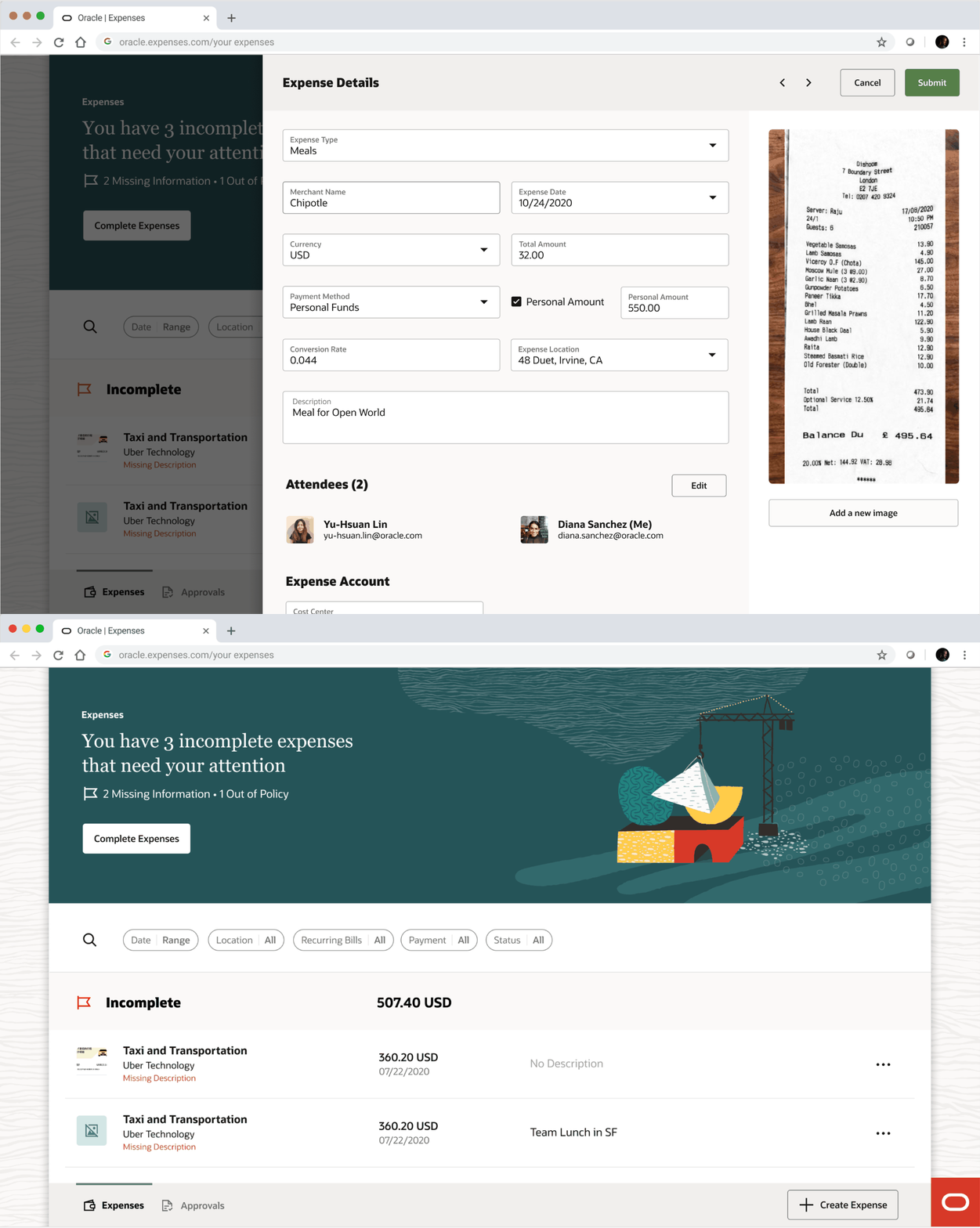
We took a dual-track approach: continuously improving the existing product while simultaneously rebuilding the next generation from the ground up on Oracle’s new technology stack and emerging Redwood design system. We redesigned the experience around what people were actually trying to accomplish, reducing manual effort by as much as 75%. The work became an early proof point for Oracle’s broader design transformation and was featured onstage at Oracle OpenWorld 2019.

Animated demo of the redesigned expense detail screen, with an itemized expense shown alongside its scanned receipt
The redesigned expense detail screen, with the scanned receipt shown alongside every field for a quick check.
2020–2022

Accounts Payable in Oracle ERP

Outcome50% reduction in manual entry time

Details coming soon

Oracle AP Invoicing was another critical workflow in Oracle’s broader push to modernize its ERP portfolio. For some customers, AP teams were processing as many as 30,000 manually entered invoices each month, with individual clerks completing roughly 65 entries a day at about three minutes each. At that scale, even small inefficiencies compounded quickly—creating an opportunity to rethink how high-volume financial work got done.


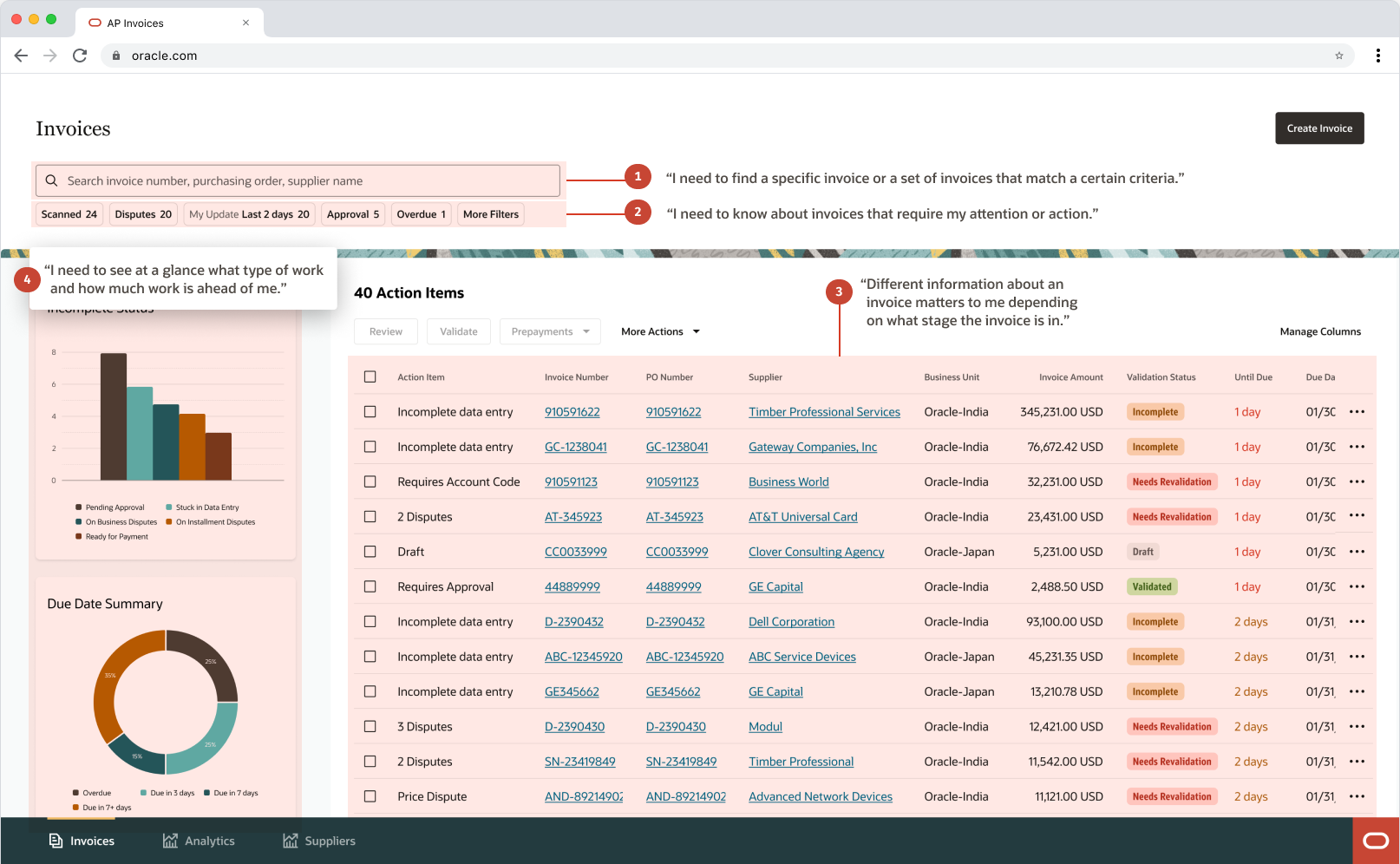
We redesigned the experience around speed, focus, and control, introducing prioritized work queues, centralized faceted search, integrated analytics, and quick actions that cut manual entry time by 50%. We also redesigned the invoice itself—an artifact reaching more than 1.7 million customers annually—as a highly visible opportunity to bring Redwood into the end-to-end experience and raise the bar for how Oracle showed up to its customers.

Animated demo of a split view matching entered invoice lines with the original invoice document
Intelligent invoice matching—the system matches entered invoice lines (left) with the original invoice (right), making it easier for AP specialists to resolve disputes by quickly spotting discrepancies.
2019–2021

Start with “Why”

RoleFounder & driver, company-wide framework

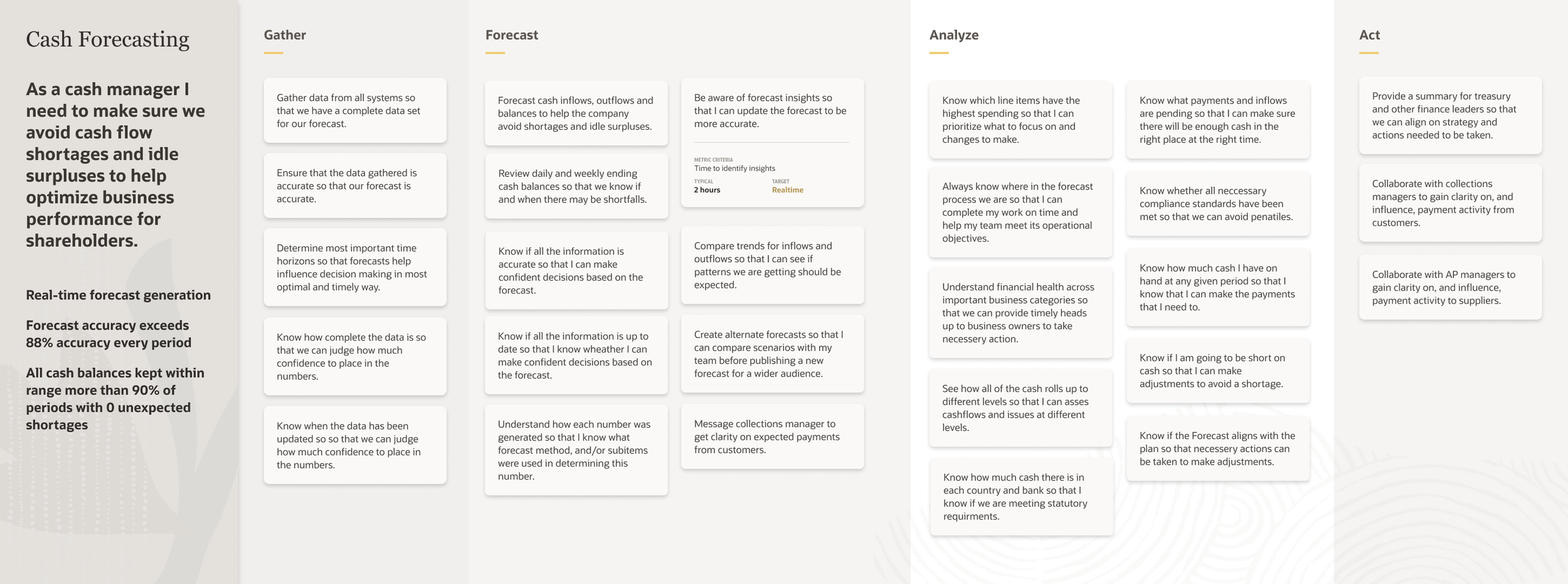
Most of Oracle’s products were still being built feature by feature, so we created a two-part framework to change that—a simple way for teams to ground every decision in the user problem they were actually solving, not just the feature list in front of them. We introduced it live to over 1,000 people, ran working sessions with eighteen product teams who wanted to go deeper, and it’s still living on publicly on Oracle’s Clarity of Purpose site.

Clarity of Purpose—the framework presentation, introduced live to over 1,000 people.